From some time ago, I’m using a amazing admin tool named clusterSSH (aka cssh).
With this tool (packages available for GNU/Debian like distributions, at least), we
can interact simultaneously against a servers cluster. This is very useful,
when your are making eventual tasks in similar servers
(for example, Tomcat Cluster nodes, … ) and you want execute the same intructions
in all of them.
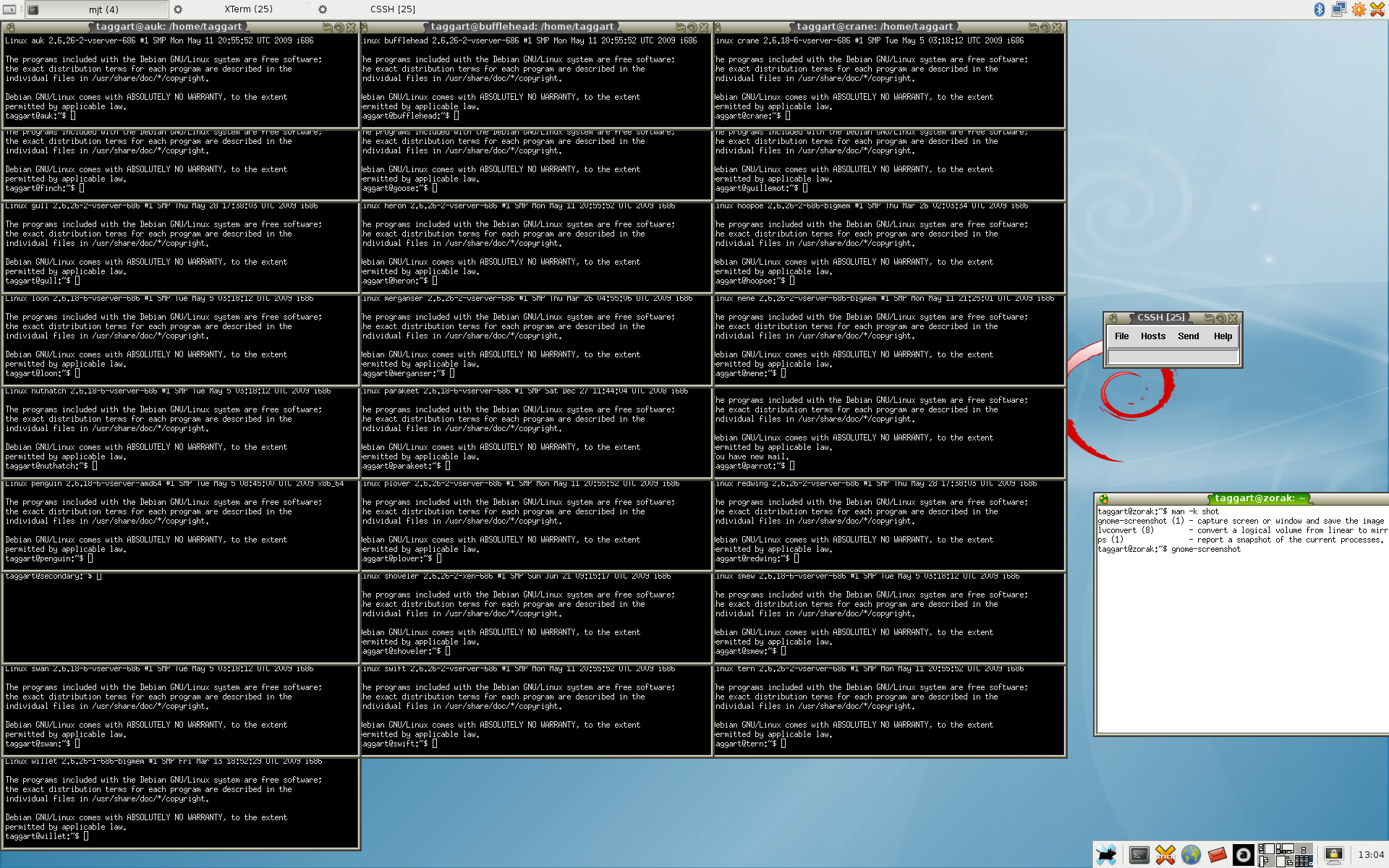
My config (~/.csshrc) file for cssh is look like to the default settings:
auto_quit=yes
command=
comms=ssh
console_position=
extra_cluster_file=~/.clusters <<<<<<<<<
history_height=10
history_width=40
key_addhost=Control-Shift-plus
key_clientname=Alt-n
key_history=Alt-h
key_paste=Control-v
key_quit=Control-q
key_retilehosts=Alt-r
max_host_menu_items=30
method=ssh
mouse_paste=Button-2
rsh_args=
screen_reserve_bottom=60
screen_reserve_left=0
screen_reserve_right=0
screen_reserve_top=0
show_history=0
ssh=/usr/bin/ssh
ssh_args= -x -o ConnectTimeout=10
telnet_args=
terminal=/usr/bin/xterm
terminal_allow_send_events=-xrm ‘*.VT100.allowSendEvents:true’
terminal_args=
# terminal_bg_style=dark
terminal_colorize=1
terminal_decoration_height=10
terminal_decoration_width=8
terminal_font=6×13
terminal_reserve_bottom=0
terminal_reserve_left=5
terminal_reserve_right=0
terminal_reserve_top=5
terminal_size=80×24
terminal_title_opt=-T
title=CSSH
unmap_on_redraw=no
use_hotkeys=yes
window_tiling=yes
window_tiling_direction=right
The ~/.clusters file is the file which defined the concrete clusters (see man ):
# home cluster
c-home tor@192.168.1.10 pablo@192.168.1.11# promox-10.40.140
promox-10.40.140 10.40.140.17 10.40.140.18 10.40.140.19 10.40.140.33 10.40.140.17 10.40.140.18 10.40.140.33# kvm-10.41.120
kvm-10.41.120 10.41.120.17 10.41.120.18
When I want work with c-home cluster, we execute de cssh as following:
# cssh c-home
In addition, I have written a tiny python script that automatized the cluster lines generation. This script is based in pararell executed ICMP queries. Thats is cool when your servers are deploying in a big VLAN or the number of them is big. In this cases, we can execute my script to found the servers.
# ./cssh-clusterline-generator.py -L 200 -H 250 -d mot -n 10.40.140 >> ~/.clusters
# mot-10.40.140-range-10-150
mot-10.40.140-range-10-150 10.40.140.17 10.40.140.19 10.40.140.32 10.40.140.37
Finally, … the script:
import os
from threading import Thread
from optparse import OptionParserclass Thread_(Thread):
def __init__ (self,ip):
Thread.__init__(self)
self.ip = ip
self.status = -1
def run(self):res = os.system(“ping -c 1 %s > /dev/null” % self.ip)
res_str = “Not founded”self.status = res
threads_=[]
ips = “”parser = OptionParser()
parser.add_option(“-n”, “–net”, dest=”network”, default=”10.121.55″,
help=”Class C Network”, metavar=”NETWORK”)
parser.add_option(“-L”, “–lowrange”, dest=”lowrange”, default=”1″,
help=”Low range”, metavar=”LOW”)
parser.add_option(“-H”, “–highrange”, dest=”highrange”, default=”254″,
help=”High range”, metavar=”HIGH”)
parser.add_option(“-d”, “–deploy”, dest=”deploy”, default=”Net”,
help=”Deploy name”, metavar=”DEPLOY”)
parser.add_option(“-v”, “–verbose”, dest=”verbose”,
default=False, action=”store_true”,
help=”Verboise mode”)(options, args) = parser.parse_args()
low_range = int(options.lowrange)
high_range = int(options.highrange)
net=options.network
deploy_id = options.deploy
verbose=options.verbosefor i in range (low_range, high_range+1):
ip = net + “.” + str(i)
h = Thread_(ip)
threads_.append(h)
h.start()for h in threads_:
res_str = “Not founded”
h.join()
count=0if h.status == 0:
count = count + 1
res_str = “FOUNDED”
if verbose:
print “Looking host in %s … %s” % (h.ip, res_str)
ips += h.ip + ” ”if verbose:
print “Finished word. %s host founded” % countprint “”
print “# ” + deploy_id + “-” + net + “-range-” + str(low_range) + “-” + str(high_range)
line = deploy_id + “-” + net + “-range-” + str(low_range) + “-” + str(high_range) + ” ” + ips
print line


 503: Service Unavailable
Leave a comment